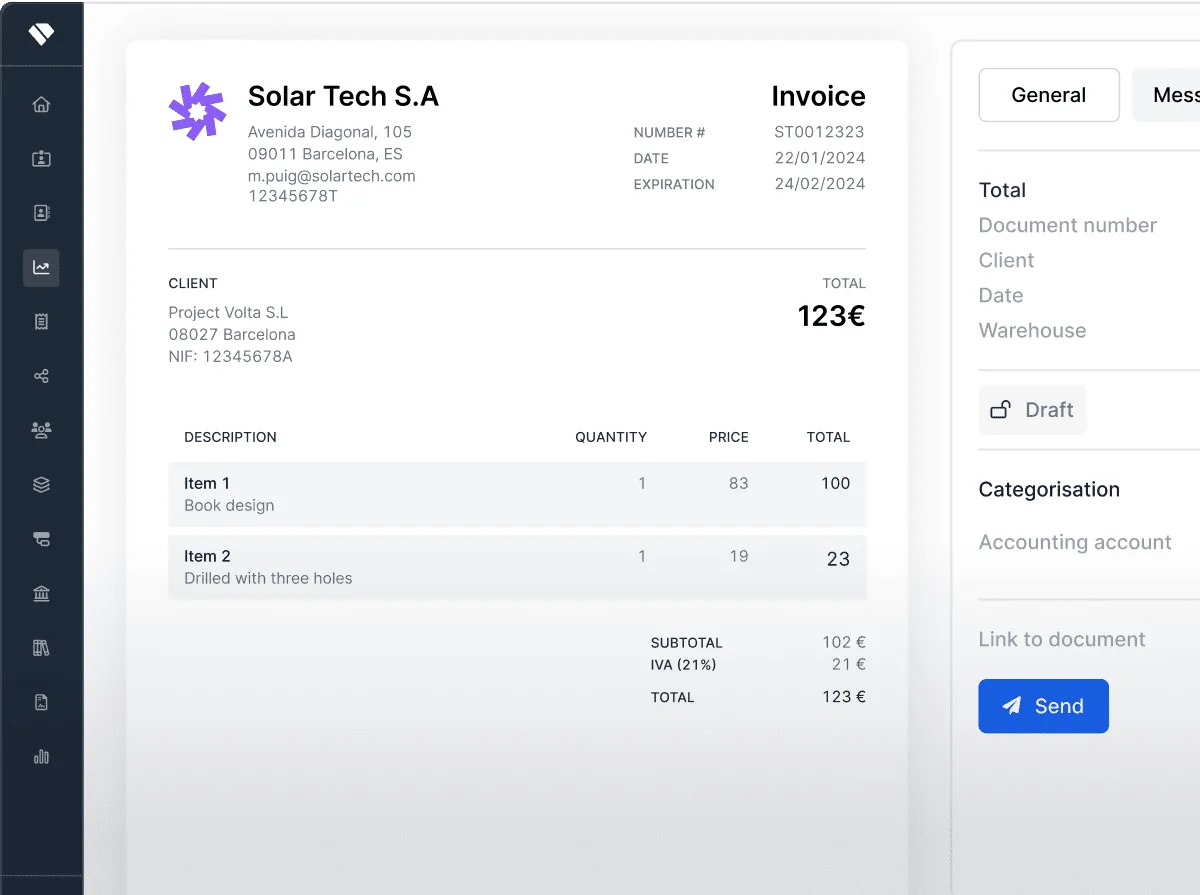
Monitor your changing inventory in real-time and control your sales cycle.

Create and manage different types of products — then create custom categories to classify them.
Make groups of variants with different options for an agile and personalized management.
Add multiple sales prices to your products and manage products with lots or serial numbers.

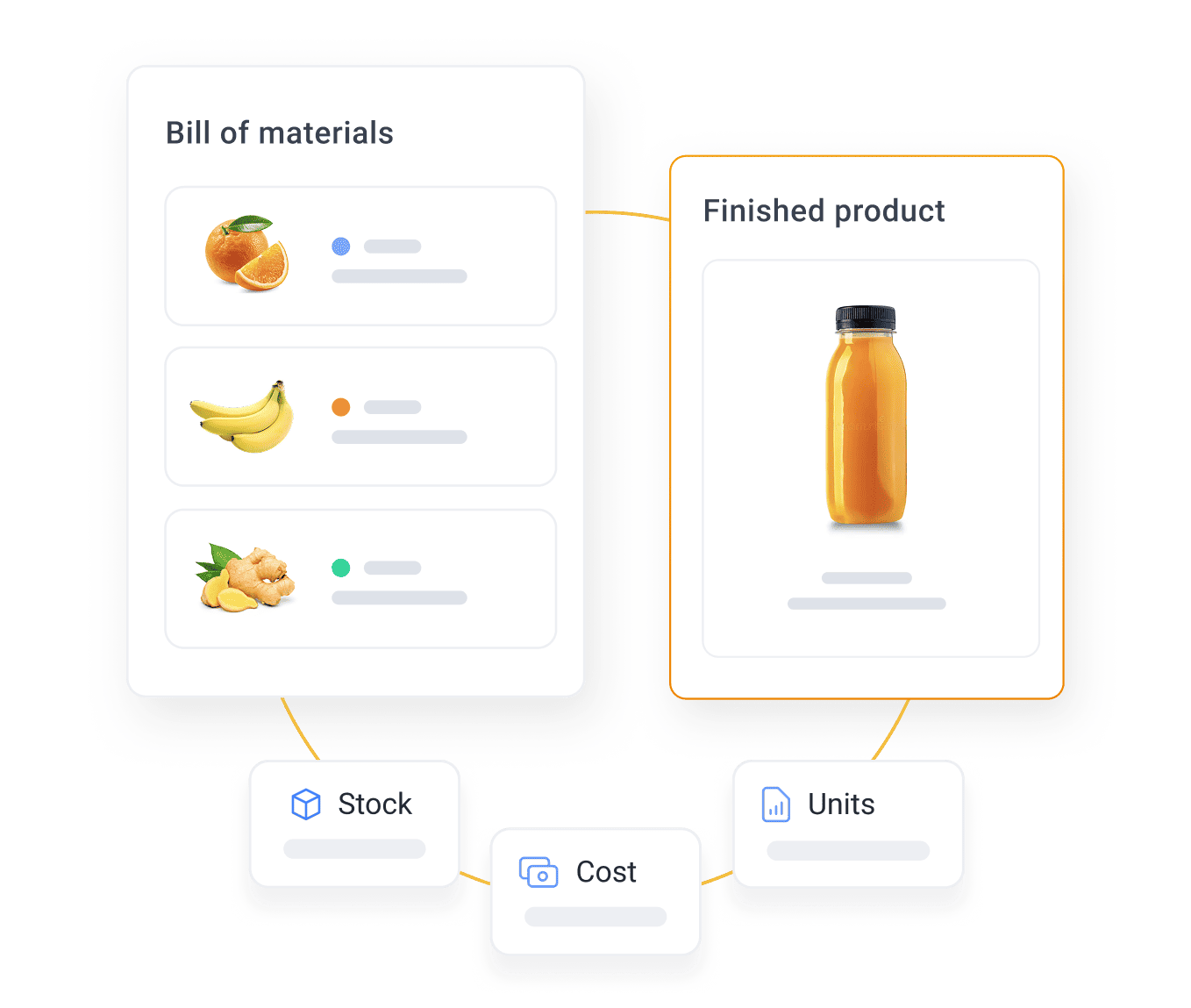
Automatically calculate the manufacturing price of finished products, taking into account purchase prices and labour costs.
Create Bills of Materials for finished products, specifying the components and units required per production.
With rapid manufacturing systems, choose finished products to manufacture, increase their stock, and consume materials.
Generate and print production orders, detailing the list of materials required for production.
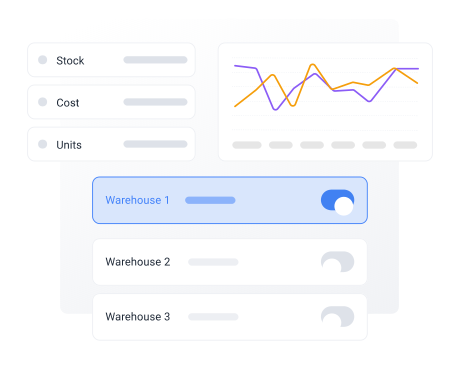
Manage your stock in different warehouses and execute stock adjustments and transfers.
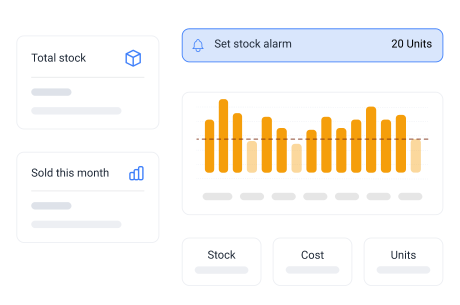
Assign alarms and check which products are below the stock limit.
Use reports to analyse your product metrics and check the stock value by date.
Manage incoming and outgoing goods with sales and purchase orders and delivery notes.
Use the barcode scanner to send or receive your products.
Create pipelines to manage the status of your orders.
Create a fully customizable product catalog which shows your shining products.
Integrate with your favorite e-commerce tools like Shopify, PrestaShop, and Amazon.
Import your products and synchronize the stock levels between your online shop and Holded.

What is inventory?The term refers to the list of goods a company has in storage with the purpose of carrying out a specific operation—such as selling, renting, purchasing, using, or transforming them. Therefore, inventory management is all about coordinating the intake, administration, and output of the materials a business needs to carry out its activity.
This makes inventory management a key component of cost accounting (also known as analytical accounting). Alongside other techniques in different areas, it plays a vital role in analyzing a company’s cost structure and optimizing both warehouse operations and overall workflow.
Because, in many cases, the health of your inventory directly impacts the health of your business.
Optimizing inventory means optimizing the entire business. That alone says a lot about how important it is. The benefits of effective inventory management include:
✓ Significantly reducing inventory holding costs, as proper management ensures that stock is kept for the shortest time possible.
✓ Helping calculate and adjust the production cost of raw materials more accurately.
✓ Improving the accuracy of demand forecasting, helping to avoid both stock outs and overstocking—both of which can lead to financial losses.
✓ Preventing losses, misplacements, and theft, which could otherwise go unnoticed without constant and effective monitoring.
✓ Connecting inventory with other business areas, helping to improve workflows across the entire company.
There is no single inventory control system that works for every business.
Each company must establish its own management structure—often by adapting one of the most widely used and proven systems. The main idea is simple: if the goal is to control a company’s physical assets, the starting point of any management system should be to list those assets based on certain key characteristics.
The most common ones usually include a description of the item, its quantity, and its location in the warehouse. But again—what one business needs to highlight and track may be totally irrelevant for another.
The important thing is that the listed characteristics allow you to keep full control over your stock and know exactly when to restock. And if your system can also help you make reliable predictions about material flow—even better.